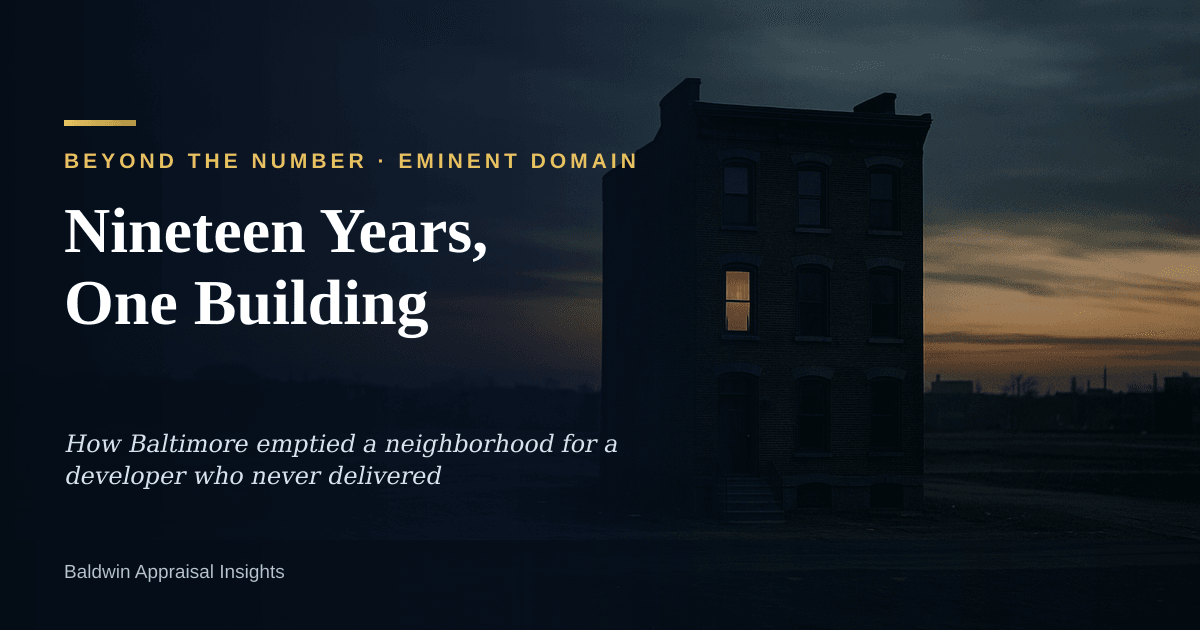

Nineteen Years, One Building: How Baltimore Emptied a Neighborhood for a Developer Who Never Delivered
WEST BALTIMORE - INVESTIGATION
The city used its most drastic power to clear a historic Black community for an $800-million vision. Two decades later, almost none of it exists — and the people who were forced out are still counting what they lost.
There is a mural painted on the side of Sonia Eaddy's rowhouse in West Baltimore. It is twenty feet tall, and it reads: “Losing my home is like a death to me”.
For most of two decades, Eaddy lived under the threat that the sentence described. Her three-story house at the corner of North Carrollton Avenue and Sarah Ann Street sat inside the footprint of one of the most ambitious redevelopment plans Baltimore ever approved — a roughly 14-acre remake of the Poppleton neighborhood that promised upscale apartments, a hotel, a park, national retailers and a charter school, some 30 new buildings in all. A sign on Carrollton Avenue announced the future. The land behind it told the truth: block after block of cleared dirt, ringed by the handful of rowhouses still standing, waiting for a transformation that, year after year, never came.
In June 2024, after nineteen years, the city finally gave up. Baltimore's housing department terminated its contract with La Cité Development, the New York firm that had held exclusive rights to the neighborhood since 2005, citing “delays and shortcomings that we can no longer endure”. By then the developer had displaced hundreds of people, the city had spent at least $15 million of public money clearing the way, and the entire grand vision had produced exactly one thing: a single apartment complex.
To understand how a neighborhood gets erased for almost nothing, you have to start with the power the city used to do it.
What eminent domain actually means
Eminent domain is the government's power to force you to sell your property whether you want to or not. The Fifth Amendment permits it for “public use” — roads, schools, bridges — in exchange for what the law calls “just compensation”, usually fair market value. You cannot refuse; you can only argue about the price.
Poppleton was a different animal. Here the city used that power not to build something public, but to take privately owned homes from the families who lived in them and hand the cleared land to a private developer. The mechanism was a “land disposition agreement”: Baltimore would do the condemning, the buying, the relocating and the bulldozing, then deliver assembled, empty parcels to La Cité to build on. The city, in effect, became the wrecking crew for a private project.
The timing was not an accident. Just months before the deal, in 2005, the U.S. Supreme Court had blessed exactly this kind of arrangement in Kelo v. City of New London, ruling that private redevelopment promising jobs and tax revenue could qualify as a “public purpose”. Critics across the political spectrum saw Kelo as a green light for cities to bulldoze working-class neighborhoods on a developer's promise. Poppleton would become one of its starkest examples. “Eminent domain is violent”, residents would later put it.
The neighborhood that was there
The homes Baltimore marked for demolition were not blight in the eyes of the people who lived in them.
The crown jewel was Sarah Ann Street itself — a narrow alley, too tight for two cars to pass, lined with a row of brick Italianate houses built in 1870. They were modest and beautiful: flat slanting roofs, simple wooden cornices set above projecting brick friezes decorated with small brick brackets. By 1880, just a decade after they were built, the block was home almost entirely to Black families, some of the first affordable housing for African Americans in the city after the Civil War. Over the following century, as alley houses were demolished across Baltimore and up and down the East Coast, the Sarah Ann Street block survived — the last of its kind in the neighborhood, and one of the last anywhere. Generations of Black families had owned and lived in these houses since Reconstruction. (In 2023 the city would finally make the block a local historic district — a year after fighting to tear part of it down.)
Elsewhere in the project's path stood other pieces of the city's nineteenth-century fabric, including the Boss Kelly House and a historic row on West Saratoga Street. The Edgar Allan Poe House, the cramped brick home where the writer once lived, still sits in the middle of it all, now a small museum.
On paper, the city would eventually take more than 500 properties. Many were already vacant — the “holes in the doughnut”, as the developer once called them. But the doughnut was full of people. More than 100 households were still living there, some for thirty years or more, when the letters began arriving telling them their homes would be condemned.
How the residents felt
They experienced it as a death in the family, and they described it that way.
“This is my home. This is my grandkids' home”, Eaddy said of the house she fought to keep. “This is where Thanksgiving happened. This is where the cookouts and the birthday parties in the yard happened”. On a neighboring plot that had been reduced to rubble, she remembered, “we used to have family reunions here” — now, she said, it was an embarrassment to invite anyone over. What was being destroyed, she insisted, was not just buildings: “What makes a community is houses. People. And the loss of the people and the houses — it's not a neighborhood anymore”.
Others did not get to fight and win. Yvonne Gunn, in a court filing, described what vanished around her: “There were maybe 70 or 80 houses just like mine in Poppleton. They were wiped off the face of the earth”. Angela Banks, who had lived in the neighborhood for thirty years before she was displaced in 2018, said she received no compensation or relocation assistance and struggled for years afterward to find affordable housing. Carol Ott, of the Fair Housing Action Center of Maryland, summed up the message residents felt the city was sending: “You are not worth investing in. We can move you around like pieces on a Monopoly board”.
Why the city did it
The city's case rested on decades of genuine decline. Poppleton sits on the wrong side of Martin Luther King Jr. Boulevard, a kind of informal moat separating it from the investment that flowed to downtown and the waterfront. It had suffered the same hollowing that gutted much of Baltimore — population loss, job loss, block after block of vacant rowhouses. Officials argued the neighborhood would never recover on its own, that only a large outside developer, lured with cleared land and public subsidy, could reverse it, and that the rapidly growing University of Maryland BioPark next door made the moment ripe.
It was a familiar bet. “Baltimore is desperately seeking a savior”, Ott said — “the idea is the city doesn't have the resources or the capital or the people to make it happen, so the city goes outside to find this magic bullet”. The financing tool the city reached for, tax-increment financing, rested on what officials called a “but-for” test: the premise that the project would never happen but for tens of millions in public bonds. In Poppleton, the city would ultimately approve up to $58 million in such bonds, on top of a $7.5 million state tax credit and a $56 million federally insured construction loan. The public, in other words, would underwrite almost the entire thing.
The developer they chose
The man Baltimore bet on was Daniel Bythewood Jr., the son of a wealthy Long Island orthodontist, and his newly formed firm, La Cité — “the city” in French. Neither had ever done a large-scale, multiphase neighborhood redevelopment. Community members, a panel of city employees, and the office overseeing the selection all reportedly warned that the firm was too inexperienced for a job this size. Officials under then-Mayor Martin O'Malley chose it anyway. Reporting later noted that in the summer of 2005, around the time the deal was being negotiated, O'Malley attended a political fundraiser at the Long Island home of Bythewood's father.
Bythewood's vision, by his own telling, was shaped less by Baltimore than by television. He said he wanted to “control the dirt” the way a drug lord does on The Wire, packing in enough density that dealers couldn't, as he put it, buy up alternating rowhouses to watch the block. In his financing application he claimed the HBO series The Corner had been filmed in Poppleton — it wasn't — and described rampant open-air drug dealing, even though residents had already cleared a vacant lot and turned it into a park years earlier. The pitch was grand: he would recreate Tulsa's Greenwood District, “Black Wall Street”, with 30 buildings and roughly 1,800 apartments. What he built was two towers that one critic called “gentrification gray”.
Nineteen years, almost nothing
A 262-unit complex called Center/West opened on Schroeder Street in 2019 — two buildings, the first and only piece of the plan ever finished. The hotel, the retail, the park, the charter school and the long-promised grocery store never came. Yet the slow pace never stopped the city from continuing to buy, demolish and hand over more property. There had been one chance to escape: in 2012 the Rawlings-Blake administration tried to terminate the agreement, and La Cité took the city to federal court and won, keeping the deal alive for another twelve years.
What the project did reliably produce was income for the people who ran it. Financial documents filed in a later lawsuit showed La Cité spent roughly $7.3 million on executive compensation, operations and overhead between 2005 and 2022 — steady money flowing out even as construction sat still. The company logged $16,000 in political donations as “marketing” expenses, and at one point an investor reimbursed it $16,000 for “marketing”. Even the partial rescue of Sarah Ann Street became a payday: to remove the contested homes from the project, the city paid La Cité $210,000 to give up its right to demolish Eaddy's house, plus $50,000 for the empty home next door, while the nonprofit restoring the alley houses had to pay La Cité $2,000 for each of the eleven it rehabs. The developer, as one account put it, got paid to no longer develop land he never owned.
The one building that did rise has struggled ever since. Center/West's twin towers — Avra and Cirro — are near-mirror images outside but felt like different worlds inside, residents said: Avra with its pool and rooftop lounge, Cirro with dirty hallway carpets, an emergency line nobody answered, and a churn of Airbnb guests and traveling nurses filling the units it couldn't lease. “Living here makes me feel like this is nothing but the projects”, one tenant said. The ground floor meant for shops sat as bare gravel. The complex was tall enough to throw a shadow over Poe's little house across the street. By late 2024 about 40 percent of its market-rate apartments were empty, the retail entirely so, and the building had lost nearly $16 million — even as La Cité still had not begun repaying the principal on its $56 million federal loan. Asked whether he had ever paid the special tax meant to cover the public bonds, Bythewood answered: “I just pay my property taxes when they are due”. (Center/West has also been a chronic water-bill problem, racking up arrears reported at $520,667 and later more than $730,000, and drawing two separate city lawsuits.)
In 2023, residents took their case national, asking the U.S. Department of Housing and Urban Development to investigate whether the city's policies in Poppleton perpetuated racial segregation and violated fair-housing law by disproportionately displacing Black and low-income people — a textbook example, critics said, of mid-twentieth-century “slum clearance” dressed up as revitalization.
The fight, and the reckoning
What finally turned the tide was not City Hall but a handful of residents who refused to leave. Eaddy and her neighbors held rallies, printed fliers, dug through land records and wore officials down. In July 2022, Mayor Brandon Scott announced that the Eaddys could stay and that the Sarah Ann Street houses would be saved and handed to a local nonprofit, Black Women Build–Baltimore, to restore and sell to Black homeowners. “This victory is for us — all of us”, Eaddy told the crowd. “It's not just Poppleton”.
The end, when it came for La Cité, was almost mundane. The developer missed a deadline to prove it had financing for a senior apartment building, defaulted, and then asked the city for what officials described as “basically an open-ended extension” — when the contract allowed no more than 60 days. The city had finally run out of patience.
But termination did not bring a clean ending. Even after losing its exclusive rights, La Cité still holds the parcels already conveyed to it, including the Center/West site, and is locked in litigation with its own investor, Arctaris Impact Investors, which had put $13.1 million into the stalled senior-housing phase. The two sides agreed La Cité would refund about $12 million by a deadline in late December 2024; it missed that too, and in February 2025 a judge handed Arctaris control of the phase. Center/West itself was listed for sale amid the dispute. A separate lawsuit by residents against the city and the developer was dismissed, a dismissal upheld by the Fourth Circuit in 2026. New plans for the emptied land — including roughly 180 single-family homes — have since been floated, a fresh start on ground that took nineteen years to clear.
For the people who were moved around the board, the math is simpler. “We live with what they did to us every day”, a Poppleton leader said after the lawsuit was thrown out.
How bad was it, and was eminent domain necessary?
By the time La Cité arrived, Poppleton had absorbed decades of disinvestment. Like much of West Baltimore, it had lost population and jobs and accumulated vacant rowhouses; the developer's later description of “holes in the doughnut” captured a real pattern of scattered abandonment. City officials argued that the neighborhood could not recover on its own, that assembling land for a single large project was the only realistic path, and that the expanding University of Maryland BioPark next door made the moment opportune.
Two facts complicate that case. First, the most severe descriptions of the neighborhood were contested. La Cité's tax-financing application cited rampant open-air drug dealing and claimed the HBO series The Corner had been filmed in Poppleton; the latter was untrue, and residents had earlier cleared a vacant lot into a park and organized to push out dealers. The Sarah Ann Street houses were occupied, structurally intact and historically significant, recognized as a local historic district in 2023. Second, the timing of the blight was partly a product of the project itself: after the city designated the area for acquisition in the early 2000s, it largely stopped investing and began buying and demolishing, so a share of the vacancy later cited as justification accrued during, not before, the redevelopment effort. Contemporary coverage described a neighborhood “ground down and depopulated”.
Whether eminent domain was necessary depends on how it is measured. Assembling fragmented, tax-delinquent or absentee-owned parcels is difficult without some public acquisition power, and for genuinely abandoned properties that tool is widely used. The Poppleton agreement, however, applied it to occupied and maintained homes as well as vacant ones, and transferred the cleared land to a private developer — an arrangement the U.S. Supreme Court had permitted months earlier in Kelo v. City of New London (2005), and that several states restricted by statute in the years that followed. Judged by results, the public-benefit rationale is difficult to sustain: more than 100 households were displaced and a roughly 14-acre footprint largely cleared, and after nineteen years the only completed structure was a single 262-unit apartment complex.
Responsibility is similarly divided. La Cité had no large-scale development experience, projected far more than it delivered, and drew roughly $7.3 million in compensation and overhead between 2005 and 2022 while construction stalled; the 2008 financial crisis was a genuine early obstacle to financing, but it does not account for the years of inactivity that followed. The city, for its part, selected the firm despite documented warnings about its inexperience, agreed to perform the acquisition and demolition itself, extended the agreement repeatedly, continued clearing land while little was built, and — after failing to terminate the deal in court in 2012 — expanded its support in 2015 with up to $58 million in tax-increment bonds. By the available record, both the developer's performance and the city's oversight fell short, and the neighborhood absorbed the consequences of each.
The honest counterweight
For anyone weighing the area's trajectory today, Poppleton is the cautionary half of the story. One block south, the momentum along the market and BioPark corridor is real. But Poppleton itself remains a nineteen-year redevelopment failure: hundreds of properties taken by eminent domain, one apartment building to show for it, the developer terminated in June 2024, and a neighborhood still carrying very high vacancy and long-run population loss. There is no single new master developer with a financed plan in the ground today. The honest read is “the worst is behind it and the path is clearing”, not “a new project is rising”. The momentum nearby is genuine but fragile and uneven — strongest on the market/BioPark side, weakest on the vacant-Poppleton side.
Sources
- Baltimore Brew - Poppleton developer's agreement is terminated (Jun 2024)
- Baltimore Beat - Land Grab: Why a Desperate City Kept Cutting Deals With a Developer Who Didn't Deliver
- The Baltimore Banner - Why Baltimore chose an untested developer
- The Baltimore Banner - How a NY firm made millions off a struggling development
- The Baltimore Banner - Poppleton apartment complex for sale as investor wants its money back
- The Baltimore Banner - Investor Arctaris sues La Cite for control
- The Baltimore Sun - Sonia Eaddy wins decadeslong fight to save her home (Jul 2022)
- The Baltimore Sun - Poppleton residents liken it to a 'family' being broken apart (Jul 2021)
- The Baltimore Sun - City sues developer for $478K in unpaid water bills (Apr 2025)
- Baltimore City CHAP / Baltimore Heritage - Sarah Ann Street historic district
- The Real News - 'Eminent domain is violent': Poppleton residents
- Baltimore Brew - 'We live with what they did to us every day' (Jun 2025)
- The Daily Record - Poppleton lawsuit dismissed by 4th Circuit (May 2026)
Compiled and fact-checked from independent local reporting, 2019–2026.