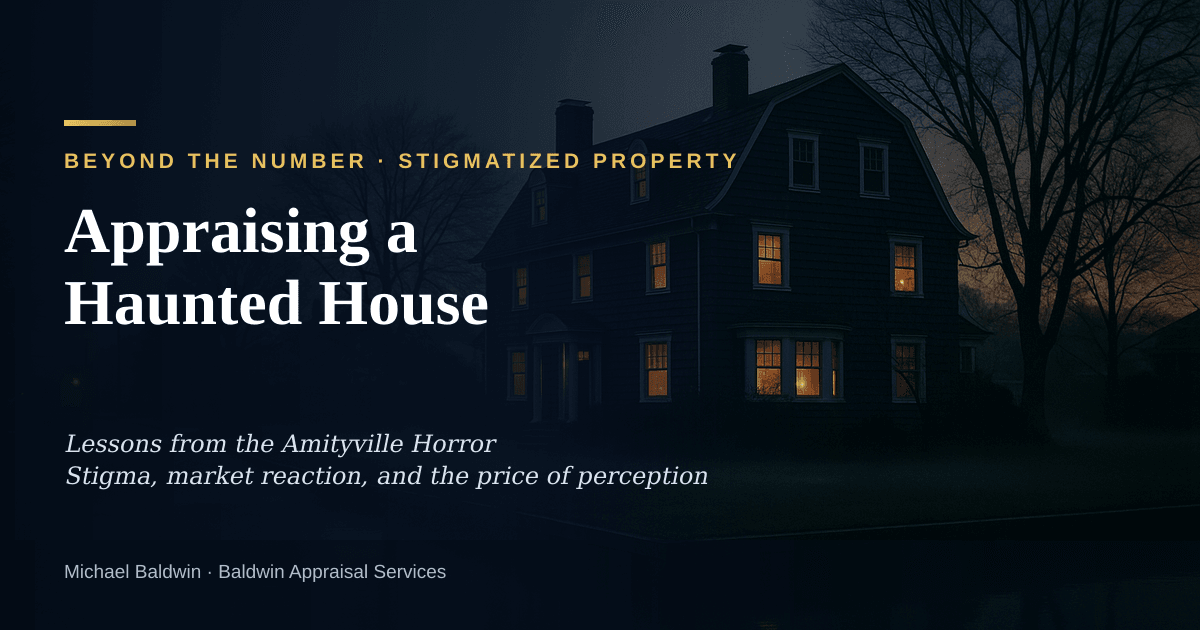
Appraising a Haunted House: Lessons from the Amityville Horror

Michael Baldwin
The notion of a “haunted” house may sound sensational, yet for appraisers it represents a legitimate valuation challenge. At Baldwin Appraisal Services, LLC, we often encounter situations where buyer perception—not physical condition—drives market behavior. Few examples illustrate this better than 112 Ocean Avenue, Amityville, New York, the site of the infamous Amityville Horror.
What Makes a Property “Stigmatized”?
A stigmatized property is one that suffers market resistance due to psychological or emotional factors unrelated to its construction or utility. The Appraisal Institute’s AO-9 categorizes such conditions as detrimental influences requiring evidence-based analysis.
The 1991 “Ghostbusters” case, Stambovsky v. Ackley, established that if a seller publicly promotes a haunting, that reputation becomes material to value. In other words, public perception itself can alter market value, even when the building remains structurally sound.
Case in Point: The Amityville Horror House
Address: 112 Ocean Avenue, Amityville, NY 11701 (later renumbered 108 Ocean Avenue).
Background: In 1974, six members of the DeFeo family were murdered in the home. The following year, George and Kathy Lutz purchased it for $80,000 (approximately $430,000 in 2025 dollars). Within a month they fled—claiming supernatural disturbances—sparking The Amityville Horror book (1977) and the subsequent films.
Sales History Snapshot
| Year | Reported Price | Context | Market Commentary |
|---|---|---|---|
| 1975 | $80,000 | Lutz family purchase, post-murders | 5 bedrooms, 3½ baths; a discount vs. neighborhood peers at ~$90–100K. |
| 1977–1997 | ~$55,000 – ~$310,000 (resales) | Multiple owners | Modest appreciation; stigma held values below the local median for years. |
| 2010 | $950,000 | Restored colonial | Sold below its earlier $1.15M asking; renovations and time softened the stigma. |
| 2012 | Relisted $1.35M → $955K (did not sell) | Owners citing divorce | Ambitious ask; withdrawn without a sale. |
| 2016 | Listed $850,000 | Coldwell Banker listing | Repriced to meet the market. |
| Feb 2017 | $605,000 (verified) | Conventional buyer | Closed roughly 29% below the $850K ask—evidence the stigma discount persisted even decades later. |
Sources: NBC News / CNBC (2016 listing); 6sqft and LI Haunted Houses (Feb 2017 sale); Biography.com (2025); Newsday and New York Times real-estate archives.
Market Behavior and Stigma Decay
Initial sales following the murders reflected a temporary stigma discount of roughly 10–15 percent, consistent with studies on psychologically impacted properties. By the 1990s, renovations, the passage of time, and a deliberate address change had diluted the effect. Yet the 2017 sale—closing well below asking—shows the stigma never vanished entirely; it moderated. This trajectory illustrates the “time-decay principle” often cited in the Appraisal Journal and AO-9: as publicity subsides and physical quality improves, stigma diminishes but can leave a measurable residue.
Market reaction, not folklore, determines measurable value impact.
Analytical Framework for Appraisers
- Comparable Sales — Identify paired sales with similar notoriety or neighborhood conditions.
- Public Awareness Audit — Confirm how widely the reputation is publicized (tourism listings, media hits, online search results).
- Survey Evidence — Interview agents and buyers to estimate expected discount or extended marketing time.
- Income Potential — If notoriety can be monetized (themed rentals, film licensing), model potential premium under proper zoning.
- Time-Decay Adjustment — Evaluate resale performance over time to measure stigma dissipation, as demonstrated by Amityville’s trend.
Applying the Framework to a Typical “Haunted” Home
In a recent internal Baldwin Appraisal Services case study, a Victorian home of similar vintage with a regional haunting reputation yielded the following:
| Data Source | Result | Adjustment |
|---|---|---|
| Baseline non-stigmatized value | $640,000 | — |
| Stigmatized paired-sales set | $575,000 – $605,000 | –5% to –10% |
| Agent/buyer survey | 7% mean expected discount | — |
| Final indicated value (as-is) | $592,000 (rounded) | –7.5% stigma adjustment |
The discount closely mirrors the early Amityville resales and broader academic findings on stigmatized housing.
Disclosure and Reporting Considerations
- Scope of Work: Document media coverage, public reputation, and market sentiment.
- Extraordinary Assumptions: Assume public awareness consistent with current publicity.
- Hypothetical Conditions: Apply only if valuing the property as un-stigmatized.
- Limiting Conditions: Recognize that public perception evolves; today’s stigma may be tomorrow’s curiosity.
- Ethics and Compliance: Follow USPAP Standards 1 & 2; maintain neutrality toward supernatural claims.
Professional Insights
- Stigma Is Quantifiable: Empirical research and paired sales demonstrate real, measurable market impacts.
- Marketing Matters: Rebranding or address changes, as with Amityville’s renumbering to 108 Ocean Ave., can moderate effects.
- Income Potential Exists: Under proper permitting, “haunted” branding can generate niche revenue that offsets stigma.
- Documentation Ensures Defensibility: Retain all evidence—press coverage, listings, survey data—in the workfile.
Conclusion
The story of the Amityville Horror proves that even extreme stigma can fade over time—while the property’s 2017 sale below asking reminds us the effect can linger for decades. At Baldwin Appraisal Services, LLC, our responsibility is not to judge the paranormal but to interpret how market participants react to perception—and to translate that behavior into a credible opinion of value. Haunted or not, every property deserves an appraisal grounded in evidence, transparency, and USPAP-compliant analysis.
References
- Appraisal Institute, Real Estate Damages: Analysis and Valuation of Impaired Property, 3rd Ed., 2022.
- Appraisal Institute, Advisory Opinion 9 (AO-9), detrimental conditions in valuation.
- Stambovsky v. Ackley, 169 A.D.2d 254 (N.Y. App. Div. 1991).
- Chapman, J.D. et al., “Stigmatized Properties and Housing Values: An Exploratory Study,” 2019.
- McKissock Learning, “Appraising Stigmatized Properties: Challenges and Opportunities,” 2024.
- NBC News / CNBC, “‘Amityville Horror’ House on Sale for $850,000,” June 2016.
- 6sqft and LI Haunted Houses, coverage of the February 2017 sale ($605,000).
- Biography.com, “The Amityville Horror House Still Stands,” 2025.
- Kiplinger, “Selling a Haunted House? What You Have to Tell Buyers,” 2025.
- National Association of REALTORS, “Stigmatized Properties and Disclosure Trends,” 2023.
© 2025 Baldwin Appraisal Services, LLC | All rights reserved | For educational purposes only — not legal advice.
Baldwin Appraisal Services provides commercial real estate appraisals in Connecticut, New York, Massachusetts, and throughout the Northeast.